Neglectedness is an EV multiplier, not a dispositive reason
[This is the third post in my thirty-day writing challenge where I publish one blog post daily. Tune in for more if you enjoy the post!]
There is a funny word that is almost exclusive to the vernacular of the EA community, and this word bestows downright magical powers on its users.
The word I’m talking about is neglected.
I view this word as a sort of “Get Out of Jail Free” card for doing the most useless things you’ve ever heard of. Something that will happen to you if you go to parties in SF is that people will tell you what they do, and their statements will almost always be very interesting. And sometimes, you will hear something like this:
“I run a startup making fur-lined boots for honey bees. As it turns out, honey bees get really cold feet in the winter, and this diminishes their well-being by around 20%. Since there are so many honey bees, and because there are tons of butterfly effects from honey bees being happier, this would produce a sizable—but not enormous—positive good for the world. And it’s a really neglected problem, so I think it’s a pretty good use of my time.”1
You will then smile, nod, and then excuse yourself to eat some Oreos or one of the other vegan snacks they have at the party. That is, unless you’re really pushy, in which case you will ask them tons of questions about why they are doing what they’re doing. Because, like, come on. Really? That’s what you’re doing? Out of all of the things on the planet that you could spend your time on, you chose to make fur-lined boots for honey bees?
Normally I’d try to steelman this point of view. But I’ve pushed a lot of people who say things like this, and I’ve literally never heard a single good argument from any of them. It always just bottoms out in “it seems like a good idea”, or “it’s pretty neglected...”. Even if you take this person’s speculative numbers at face value, they are doing—at best—a pretty modest good. And this just pales in comparison to other things they could be doing, regardless of how neglected this current issue is. There simply isn’t an argument here. It’s just a reasoning error that the EA community frequently doesn’t punish because the person making the case used the fancy in-group word “neglected”.
To see why the case of our candidate Uggs for Bees™ CEO fails, I think it’d be useful to reflect on why neglectedness is a useful metric to judge candidate careers by. The reason neglectedness is a useful metric is simply that it raises the EV of the career in question. That’s it. Specifically, let’s say you agree that you should aim your career towards doing good. The question then arises: what to do to maximize the amount of good that you do? Really, the formula here is something like,
But it’s useful to fine-grain this a bit. First, we were implicitly referring to impact per person above. So we should calculate that instead. And actually, by inserting the identity a few times, you can arrive at this more informative formula,
You can make other considerations, but this is the formula that most EAs seem to roughly abide by. So now we can see what neglectedness actually does—it’s just a multiplier in an EV equation. Make it bigger and your expected impact increases, make it smaller and it decreases. In words, neglectedness matters because it raises the expected impact of you in particular working on a given field.
Practically, this occurs because the fruit in a field start out low-hanging, and then become progressively harder to pick as you climb up the tree of popularity. So, the expected return of an additional person working in the field is very high. For example, it’s probably more useful to be the first wild-insect-suffering reducer than the hundredth chicken-suffering reducer. Wild insect suffering is a super big deal, and there is basically no one working on it. It’s also really tractable—if you lobbied for the use of certain pesticides over others then you’d help literally billions (and possibly trillions) of insects live much better lives. Chicken suffering at the hands of factory farms is also a super big deal, but the marginal impact of another person working on it probably isn’t as high as working on wild insect suffering. So, ceteris paribus, it follows that you should work on wild insect suffering. Or, if you don’t like that example, then it’s probably more useful to start an AI safety compute cluster than to be the hundredth person on a frontier lab’s safety team. A field being neglected is connotatively synonymous with the field being easy to positively impact. One more person working in a neglected field might be worth ten people working in a non-neglected field.
But notice that all we’re doing here is an EV calculation. So neglectedness by itself says literally nothing about whether or not something is worth doing—you must consider the concomitant reasons of scale and tractability when considering what to do. For example, a super neglected question is whether or not energy drinks are actually superintelligent morally conscious agents. This would be a really big deal if true, as superintelligences probably feel suffering to a higher degree than humans do, and there are lots of energy drinks. And it’s also a completely neglected field! The horror! But obviously you should not work on this. The EV of this field is vanishingly small, and so its degree of neglect doesn’t matter.2
So now we can come full circle and see why our Uggs for Bees™ start-up was doomed from the beginning—its EV was simply much lower than tons of other alternatives.
In summary, when doing EV calculations about whether or not your career does good, it’s not enough to just consider how neglected a field is—you must consider its overall impact. You may find that it’s not as high as a number of other options, in which case you should strongly consider doing one of those other options. Your time on Earth is short—do something useful with it.
Looking at our formula above, this just means that the impact is zero on expectation, as you should give the idea that energy drinks are superintelligent conscious creatures a prior of essentially zero.
Strap yourself to the mast to save yourself from the Sirens
[This post is the second post in my thirty day writing challenge. Tune in for more if you enjoy it!]
If you reliably knew that you would make a bad decision during a certain time, would you let yourself make decisions during that time? Probably not, right? So why do you let yourself grocery shop when hungry, speak negatively when you have low blood sugar, and make key decisions when anxious?
A core epistemic skill that I’ve tried to cultivate over the years is the idea of knowing when I’m stupid, and not letting myself make decisions during these times. Like all core epistemic skills, I’ve cultivated this in response to getting repeatedly smacked across the face over and over again.
I.
Cindy is an anxious woman. Her resting heart rate is a bit high, she gets wigged out easily, and she tends to run an endless stream of disaster loops through her head at all hours of the day. Like all anxious people, her anxiety rises and falls. Maybe it rises when her blood sugar is low, when she’s under-slept, or when other things in her life are particularly stressful. Probably all three.
She, like all people, has a number of decisions to make throughout the day. Some of these decisions are big and some of them are small. Cindy reliably finds that when she’s flooded with anxiety, she repeatedly runs into certain failure modes. For example, maybe she makes elaborate plans to fix every single problem in her entire life, half-commits to it for, like, one day, and then decides that: no, what was she thinking? That plan is terrible! It’s time for another ground-breaking, earth-shaking plan that will fix every single problem in her entire life. She then half-commits to this plan, and then one day later comes to a terrible realization....
Cindy notices that this kind of planning loop stops her from making any actual progress. It’s like she’s in a car and wants to go in a certain direction, but instead she goes into a hard right turn, and then a hard left turn, and then a hard right turn, and then a hard... you get the idea. If Cindy just stuck with a plan, even if it was kind of mediocre, then she would be able to make some sort of progress over time. It’s similar to how a random walk has an expected displacement of zero, but a directed random walk has an expected displacement that grows like n, where n is the number of steps.
Since Cindy notices that she reliably gets the extremely strong urge to stop literally everything she’s doing and make a Plan to Rule All Plans when she feels very anxious, it would be a good idea for Cindy to ban herself from planning when she feels this way—to make a deontological bar1 against planning when anxious. This would likely mitigate the failure mode, as Cindy only really feels the urge to stop, drop, and re-plan when she’s very anxious, and really not otherwise.
Another way of saying this is that Cindy realized that she’s invariably stupid in this particular way when she’s super anxious, and so she bans herself from making decisions during this time.
II.
Tom, like many members of technical staff at frontier labs, is highly stressed when he comes home from work. Tom pretty frequently takes this out on either himself or his partner. He takes it out on himself by binge eating food, and takes it out on his partner by (somewhat unintentionally) being cold, snippy, and short with her.
In the moment, this of course feels justified on his end. Those donuts aren’t going to eat themselves. Tom is, after all, a researcher on the pre-training team, and so he uses his brain all day; chess players have to consume lots of calories during chess tournaments to fuel their mental energy expenditure—the same probably applies to pretraining research, right? This thought, and many others, is one of the concomitant lines of justification that Tom’s +3SD-IQ brain cooks up when he’s hungry and wants to post hoc justify his strong urge to eat terrible food—food that he unfailingly regrets eating afterward.
Similarly, in the moment, it feels correct to be rude to his partner. She asked him a dumb question, and he gave an answer that is already more graceful than should be expected of him. It’s not his fault that she can’t act like the other pretraining researchers and “just get it” the first time. But yet, after Tom eats his nightly DoorDashed Mexican food, he can’t help but feel bad for how he acted when he walked through the door. She’s not a frontier AI researcher—of course she doesn’t know the persnickety details of what he’s doing during the day. Tom ends up apologizing whenever this happens, and resolves for it to not happen again. But yet, it reliably does happen when he comes home.
It would be useful here for Tom to recognize when he’s stupid, and place a deontological bar against taking certain actions during this time. Tom reliably eats poor-quality food and is rude to his partner when he gets home. So Tom decides to place the rule that he (a) can’t eat any junk food until after dinner, and (b) has to be Jesus-levels of kind to his partner before eating dinner. This is because through empirical experience, if Tom leaves the decision to the moment when he’s stupid, he’ll make the wrong one. So he takes away the decision-making power from himself until he’s out of his stupidity.
III.
Claire is a normal human being with a strong imagination. Maybe she also leans anxious, but it’s not really noticeable during the day. But Claire has the funny recurring experience of waking up in the middle of the night feeling super anxious, or feeling like something could go horribly wrong at any moment. This often causes her serious fear and anxiety, and sometimes it causes her to take certain actions, like check her phone, turn the lights on to scan the room, and carefully craft a salt ring around her bed to prevent any Catholic demons from getting her. Whenever she finally gets back to sleep and wakes up the next morning, she thinks back to how she acted during the night and almost morbidly laughs at how stupid her actions were. She thinks of the same things that brought her anxiety at 2am, and is completely unaffected by them.
It would serve Claire well to realize when she’s stupid, and bar herself from taking any remedial actions during this time. She has empirically found that she makes downright irrational decisions during the short time period after waking up, and so she bars herself from doing anything but ignoring her scary or anxious thoughts and going back to bed. She accepts the fact that she might come across a false negative—maybe her anxious thoughts about whether or not her parents were ok combined with her 0.7% credence that ESP is real were really telling her something that one time. But probably not.
So, Claire places a deontological bar on making any decisions during this time—she pre-makes the decision when she’s smart for the times where she’s stupid.
IV.
(non-fictional example)
Bryan Johnson—the most measured man on the planet—used to consistently binge-eat every night after getting back from building Braintree Venmo. Bryan was obviously a hyper-competent individual: extremely hard-working and intelligent, with focus so sharp you could cut diamonds with it. But during the hours of 5-10pm, “Evening Bryan” took over. Evening Bryan was stressed from the day, didn’t get great sleep the night before, had multiple young kids, and also had extreme depression. (Well, Work Bryan also had all of these—but Work Bryan was occupied with work, so he didn’t really have the chance to do something like this.) Evening Bryan was a caged animal, and an entire pan of Betty Crocker Chocolate Fudge brownies was his freedom. Bryan would always binge eat tremendous amounts of food regardless of what the better-meaning Bryans wanted him to do.
So Bryan placed a deontological bar against eating during the hours of 5-10pm. Evening Bryan would valiantly protest against this dictatorial ordinance, but it worked. He stopped binge-eating, and Bryan actually credits this as one of the first steps he took toward his current Blueprint lifestyle.
V.
Around 3200 years ago, when Odysseus crossed the Tyrrhenian Sea off the coast of Southern Italy, he knew that he had to sail past the Sirens that lived on the rocks in those waters. The Sirens were known for their song—a song that compelled all men who listened to it to claw their way off of the boat and dive into the water, swimming directly into the arms of the topless bird women singing that wondrous melody. These men were then inevitably killed by these topless bird women singing that wondrous melody. But the song sure was pretty.
Knowing this devilish information, Circe instructed Odysseus to stuff his sailors’ ears with wax, thus blocking the Sirens’ song from piercing their minds.
But Odysseus wanted more.
Odysseus wanted to hear the song himself. But he knew that upon hearing their sublime song, he would surely jump to his death. So Odysseus decided to bar himself from making a decision at this time by lashing himself to the mast of his black Achaean ship. In other words, Odysseus realized when he was going to be stupid, and then placed a deontological bar on making decisions during that time.
VI.
Will Lancer2 is highly disagreeable, confident, and has strong opinions. He also considers himself pretty fair, in the sense that he will try his hardest to steelman his opponent. But even with this internal evaluation of fairness, he reliably finds that when he encounters a new view, he will frequently form very strong opinions about it extremely quickly. These opinions will usually be to the tune of “This view is completely and utterly insane, and it is mind-blowing to me that anyone rational holds it”. He will then propagate his views in a normal manner by telling others about them in-person and online.
But Will reliably finds that, after further inspection of these positions, they were actually stronger than he gave them credit for. Maybe they aren’t something he fully agrees with, but there are serious arguments for the position. For example, Will could imagine that if he had slightly different intuitive credences on a few key premises weighing on the issue, then he would believe the viewpoint he once thought was ludicrous.
So it would probably be useful for Will to bar himself from speaking harsh words about something unless he has rigorously investigated the opposing viewpoint, say, to the point of being able to write an essay on why it’s correct. Will realizes that he’s frequently wrong and stupid when the combination of relative ignorance + extreme dismissiveness arises in response to an idea, and so he shouldn’t speak with confidence about an issue before thoroughly steelmanning3 the opposing side.4
We’ve seen a lot of instances where someone realizes that they predictably make bad decisions when they’re in a certain headspace, and so this person bars themselves from taking certain actions during this time. This bar can be on specific things, like eating food, or it can be a universal bar on decision-making in general, with a pre-filled decision made ahead of time (like Claire with her post-wake anxiety and fear).
In Googling around for this post, I found that this practice actually already has a neat name: a Ulysses contract. According to Wikipedia, a Ulysses contract is a “freely made decision that is designed and intended to bind oneself in the future.” Interestingly, its name is derived from Example V above—of Odysseus (Ulysses) strapping himself to the mast, thus making a binding choice to restrict himself in the future.
The key difference between a Ulysses contract and a good ol’ fashioned resolution is the strictness of it. You should think of your future self as a caged animal that will fight with its dying breath to get what it wants in the moment—the only way to fight a creature that has just as much intelligence as you, that’s just as good at arguing as you are, and that knows all of the rationality tricks you do is to just not fight it in the first place. Get rid of your ability to make a decision in the moment rather than imploring yourself to situationally make the correct one.
If you find yourself reliably making the same bad decisions at a certain time or while you’re in a certain headspace, consider making a Ulysses contract with yourself to avoid the temptation of the Sirens.
If you haven’t seen this term before, a deontological bar is simply a rule that says that it’s never ok to do something, regardless of the reasons you might have to do it. For example, Catholicism has a deontological bar against masturbation. Masturbation is always wrong, even if not masturbating meant that e.g. an infinite number of people were to be tortured for an infinite amount of time. Similarly, lying is a deontological bar in Catholicism. The Capuchin friar Padre Pio is quoted saying that “If I could end this war with a single lie, I would not tell it.” The war he’s referring to is WWII.
Unlike Eliezer, I do believe in the process of steelmanning. The reason I consider the Ideological Turing Test insufficient is because it’s too easy to fool yourself with it—at least, it was for me. I would articulate the position I disagreed with to a defender of that position, they would agree with it, I would point out fifteen errors with what they believe, and I would walk away vindicated in my belief. But that’s really not the standard you want to shoot for. Especially if you’re good at debating or thinking about things, I would strongly recommend making the best case possible for the opposing side using all of that brainpower you have. The truth of the matter is that you are frequently the strongest intellectual opponent you have immediate access to, and using those abilities for the opposing side is good intellectual practice. As a side note, I consider steelmanning your opponent to be an application of Jesus’ dictum of loving your enemies. I will probably write a blog post later about the virtues of steelmanning in general, as well as its virtues as opposed to passing an Ideological Turing Test.
Guys, I have something to admit to you. This “Will Lancer” character in the story, the one that I told you wasn’t me? Yeah. About that.... On the bright side, I’m finding that truly steelmanning the opposing side is both fun and epistemically helpful for finding flaws in my thinking. And I only really started doing this in response to the idea that I’m writing about right now!
[This post is the first post of my thirty-day writing project, where I write one blog post per day for thirty days straight. Tune in for more!]
I, for most of my life, could have been easily identified as someone with strong ADHD, OCD, and anxiety symptoms. Now I don’t really have these symptoms. What changed, and why do I think most people can do something like this?
Disclaimer: this is an opinion post done by someone without a shred of laboratory evidence for their thesis. Take it as such. I’m going to use words in this post like “definitely” and “totally possible”—this reflects what I really think (i.e., what I’d bet money on), and it’s supported by my personal experience. The plural of personal anecdote is empirical, right? Anyway.... If you disagree with me, then fine. I don’t care. You’re right. You win. I don’t know you. I’m unaware that you’re actually the one person this advice doesn’t apply to. Awesome. You can’t get over it. You’re doomed forever. Stop reading now and save your time.
Introduction
The short answer on what changed from my childhood: I systematically changed my behavior to not exhibit any more symptoms of these disorders. To show you that this answer isn’t as trite as it seems, I’d like to take a step back and show you how I think about “three-letter disorders” (OCD, ADD, ADHD, GAD, MDD, etc.) in general. I think this is most easily introduced via an example.
Let’s say there is a kid named Johnny in your class in school, and Johnny is hyperactive, impulsive, forgetful, and a procrastinator. You end up getting tired of being around Johnny and his loser self, and so you ask him:
“Johnny, why are you so damn lazy? You are forgetful, impulsive, a procrastinator, and you distract everyone around you too! What the hell is wrong with you?”
Johnny replies,
“Well, I have ADHD! It’s not my fault that I do all of these things. My ADHD makes me hyperactive, impulsive, forgetful, and a procrastinator.”
Your eyebrow raises and you say,
“Seems suspicious Johnny—how do you even know that you have ADHD in the first place?”
With an eye roll, Johnny replies
“Ugh, I obviously have ADHD because I’m hyperactive, impulsive, forgetful, and a procrastinator!”
Wait—does Johnny have ADHD because he does all of those things, or does he do all of those things because he has ADHD? To answer this question, it might be useful to zoom out and see how psychological disorders are thought about in practice.
A rough picture of disorder classification and diagnosis
Let’s say you have some collection of traits, like forgetfulness, attention span, impulsivity, extraversion, agreeableness, etc. These traits are assumed to roughly be normally distributed—that is, it’s expected that most people have roughly average amounts of any given trait. As it turns out, some of these traits covary. Doing empirical tests tells you that for certain people, if you find out that they have a high degree of forgetfulness, they actually also have a higher likelihood of having a hard time regulating their attention span. You also find that they are unusually impulsive and tend to wildly procrastinate. You find that there are actually big clumps of traits—characterized entirely by behaviors—that tend to strongly covary in certain people, and in fact, the traits that are present are present to high amounts. Amounts that cause real negative interference in their life.
The most parsimonious explanation of this data is that there is actually one factor causing all of these different traits—let’s call this factor A for now. Some other names I considered were D and H, and actually D again. But anyway. If you find out that someone has property A, then you can reliably predict that they will exhibit a selection of traits, demonstrating each one of which to a level that negatively interferes with their life.1
This is roughly how psychological disorders are discovered and subsequently diagnosed.2 Our property A can be something like OCD, ADHD, GAD, MDD, etc. (This psychometrics-style analysis is also the cause of the best personality and IQ classifications.) These properties are abstract labels meant to classify the fact that the person with the label exhibits a multitude of correlated traits that negatively impact their lives due to their severity. These traits are assumed to have a root cause largely in a single factor, like weird dopamine uptake in the brain, or an overactive amygdala.
Inferences
There are two pertinent things to point out here. The first is that the diagnosis of a disorder is entirely a behavioral analysis. (Note that I’m counting thought patterns as behaviors—they are simply behaviors of the mind.) Disorders are diagnosed by what you do. If you didn’t do any of those things, then you would be indistinguishable from someone without the disorder, short of a brain scan. The second thing to point out is that a disorder doesn’t makeyou do anything. It just biases you towards certain behaviors and not others. When you procrastinate on your homework, it’s not because a physical ADHD demon was sitting next to you, firmly gripping your right thumb, and swiping up on Instagram reels for three hours straight—it was because you chose to doomscroll!
What’s the punchline of this? It’s that disorders are characterized by behavior, and you control your behavior, and thus you can control whether or not you “have” a disorder. If I’m focused, don’t forget things, am not impulsive, and don’t procrastinate, then I consider the fact that you ascribe the 1st, 4th, 8th, and 4th letter of the alphabet to my behavior a causally effete description. If a label can’t predict what I do, then it’s irrelevant.
*You control whether or not you have a disorder. Period.*
There are clear objections to what I’m writing here. I’m not going to exhaustively respond to them, at least in part because some of them are actually right. I believe that a small fraction of people can’t change their behavior to the point of their symptoms not dramatically impacting their life. I’m lucky that I got the level of disorders that only caused one super serious breakdown and a few failed classes instead of, like, a lifetime of misery and agoraphobia. If you are one of the unlucky few with serious mental conditions, you have my overwhelming empathy.
However, if you’re reading this, that’s simply not you. There is an overwhelming chance you are not one of these select few individuals that God chose to YOLO the serotonin and dopamine receptors of. And if you think you are, you’re probably wrong.3 Stop coping with your own failures, and take accountability for your actions. You can change the fact that you have a three-letter disorder. It just takes effort and the right way of going about things.
Steelman of the opposing viewpoint and objection handling
I think the strongest steelman of the opposing viewpoint is something like this:
“This post is wrong on a few levels. First, a psychological diagnosis is far more complicated than you let on—it takes a trained professional multiple sessions to be able to reliably discern whether or not someone has a disorder, and they have to train for, like, a decade to be able to do it accurately. Second, rejecting a label is just cope. You just don’t like the fact that you have [X] disorder, so you say that it’s all a behavioral thing and blah blah causally effete blah blah. Just because you refuse to ascribe a label to yourself obviously doesn’t mean that it doesn’t still affect your life. Third, by making this into a heroic sigma-grindset willpower thing, you’re foregoing some of the best actual treatments for your disorder. Psychologists aren’t idiots—if telling someone to ‘just change your behavior, bro’ worked, they would have done it by now. The things that actually work are medication and therapy, which show really good results in most cases. By placing the burden entirely on yourself, you ignore the most effective ways to get treatment.
Also, was your armchair nice and comfy when you wrote this post? I hope it wasn’t. You are really showcasing your ignorance about (a) psychology in general and (b) the lived experience of people with these disorders by writing this piece. Also, if you take what you said to its natural conclusion, then it would follow that psychologists shouldn’t study people with these disorders to try and make their lives better—y’know, since it’s all a behavior thing, right? All of the people helped by CBT, ERP, SSRIs, antipsychotic medication. Yeah, those people should have just tried harder instead. Lmao. Do better man.”
Whew. That was a scathing takedown of my position. Because of this, I’d like to respond with some clarification of what I actually think.
First, the psychological diagnosis picture I painted was indeed a picture, and not a photorealistic one at that. It’s more complicated than that. But really, the essential characteristics are there. The actual way psychological disorders are characterized in the DSM is by expert consensus and clinical observation—not the factor analysis picture I was painting earlier. Diagnostically, it takes a psychologist or psychiatrist interviewing you, along with first-order evidence from your childhood, to come to an accurate diagnosis of a disorder. The point I really wanted to make with the rough scene I depicted was that a “diagnosis” isn’t a psychologist reading the tea leaves and telling you they saw The Grim—it’s simply a behavioral-level analysis that could have been done if someone had followed you around with a video camera your whole life. (It’s actually the case that many disorders have overlapping trait profiles, and thus this isn’t really accurate. But I think you can see my point.) This is really what I mean by saying that a diagnosis is a behavioral thing—saying that “OCD” made you do something is reifying an abstraction. You made you do something. Yeah, maybe it seemed like pulling on the door handle three times is Definitely The Right Number of Times To Pull On A Door Handle™, but you were still the one who did it. And you could have not done it, despite the fact that your brain is telling you that if you don’t do that, your entire family will burn in Turbo Hell forever or something.
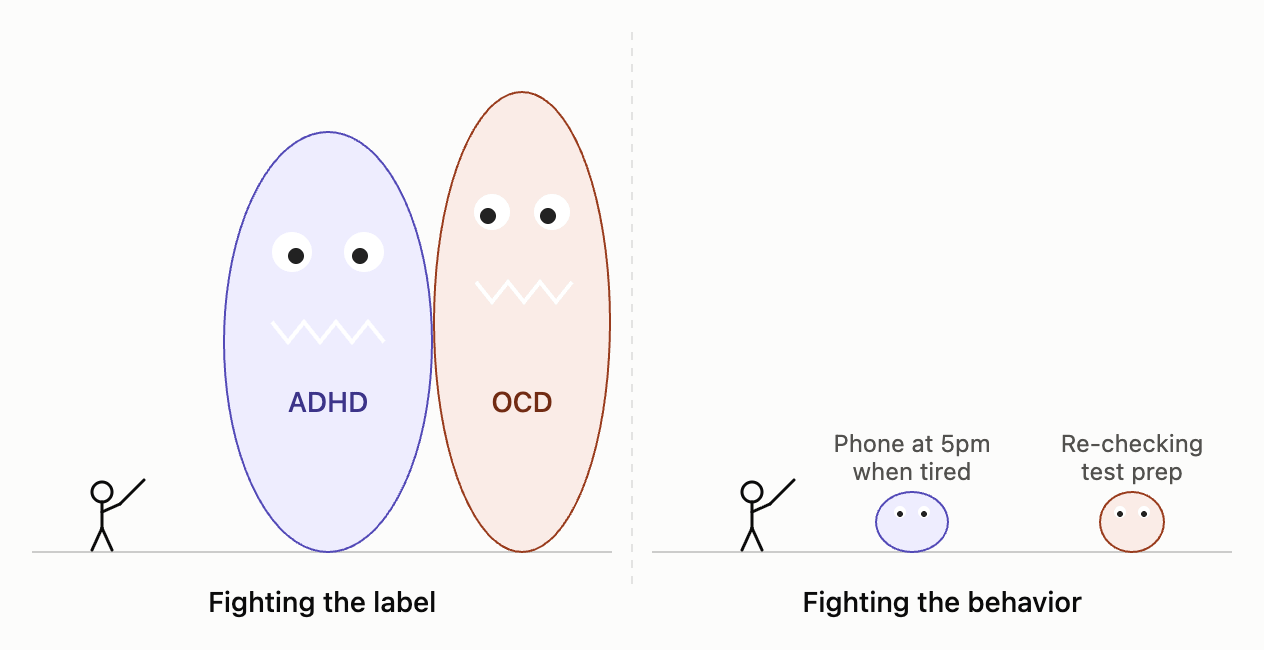
Second—am I just coping super hard here? I don’t think I am. If someone asked me if I have ADHD or OCD, I’d probably say no. This is because I don’t really exhibit symptoms of these disorders, and by my personal ontology, this means that I don’t “have” these disorders. But if you really pushed me, I’d tell you that I “used to” have these disorders. I’m not ashamed of this, which is why I’m putting it in a public blog post for everyone to see. And I’m not pigheadedly rejecting a label just for the sake of it. I genuinely think it’s unproductive to view disorders as reified abstractions—the power you gain by viewing them accurately is dramatic. Things like “procrastination” stop being these vague, unchangeable truisms about your character, and start becoming dry, third-person observations you can change. For example, you go from saying things like “I procrastinated on my work for like three hours by going on Instagram because of my ADHD” to “When I go on social media after I get back from school around 5pm and I am tired, I tend to spend too long on it.” The first thing, “procrastination” and “ADHD”, you can’t change. The second? You definitely can. And in fact, this holds for more subtle things as well. Things like “I’m ruminating on my upcoming test because of my OCD” turns into,
“I’m obsessively thinking about my test later because its presence triggers anxious feelings in me. I check and re-check my test preparation to ease my anxiety, and compulsively play out disaster scenarios and what I’d do in response to try and prepare myself for if I do poorly.”
If you’re anything like me, I can come up with pretty plausible solutions to end the behavior of the latter two examples, but I can’t end the former. Ending the former behaviors would require me to vanquish the grand beings of “procrastination” and “OCD”, while the latter are simple behavioral modifications that I can just... do.
[Thank you to Claude for generating this photo.]
Another way you could phrase this is that you are giving up personal power by being vague with your failure modes. Saying that something bad happened “because” of your three-letter disorder is simply false. You may have a greater incidence of unproductive tendencies due to the way your brain chemistry works, but all this is is probabilistic up-weighting of negative options in your purview. You can still choose the positive option. Doing this on a consistent basis will probably require you to structure your life in a way that neurotypical people don’t have to, but this is just something you can do to get the results you want. It’s behavior all the way down.
The final sub-point I’ll make on this second point is that people oftentimes over-ascribe behavior to their disorder rather than themselves. That is, if a person knows they have ADHD, and then they see themselves procrastinate, they will frequently ascribe this to their ADHD rather than just normal human behavior. You could say their “It’s my ADHD!” gun is a bit trigger-happy. The truth is that everyone procrastinates. It’s a normal thing. But the tricky part about being neurodivergent is that you don’t know what it’s like in anyone else’s mind, so you’re liable to see every deficiency in yourself as the consequence of some ethereal disorder rather than the normal human experience. This is obviously a really bad thing, as (a) it’s inaccurate, and (b) it creates a sense of powerlessness in the person experiencing it. I think really the only solution here is to not identify with a disorder in any meaningful sense. You just have to take responsibility for everything in your life and treat it as a behavioral issue. That’s the only way I’ve found to consistently and effectively change the behaviors that I don’t want in my life.
Third, am I advocating for an austere, willpower-based, grindset approach to curing disorders, thus foregoing the more effective treatments of therapy and medication? Kind of, but not really. I think there is no real way that you can consistently mitigate the symptoms of your three-letter disorder if you just try to be a sigma and grind through the pain. At least, I can’t do this. I instead advocate for using systems to change behavior. I, for example, have to implement a strict system to avoid procrastinating like crazy. If I instead tried to not procrastinate by flexing my David Goggins Just Try Harder muscles, I would wildly fail. I know this about myself at this point, and so I instead mitigate my failure modes with a system.
The rough-and-ready definition of a system is that a system is a structure that you put on your life to reduce the amount of willpower you have to use to make good decisions. The idealized version of a system that people should strive for is a system that requires you to use zero willpower to make good decisions. In practice, a “system” really just looks like some sort of schedule or to-do list for the day, along with some habits that you consistently practice. I will give some concrete advice that you can build into your own life later in this post.
I also think that therapy and medication are great! I think you should do what works, and these things work! A good therapist and/or psychiatrist is super useful in helping you get over your three-letter disorder. Talk therapy and CBT are first-line defenses for a number of disorders. And although I can’t speak from experience here, I have heard that medication is a wonderful addition to many people’s lives, especially for things like ADHD and anxiety. I think that building a good system is the crux of improvement for a disorder, and that therapy and medication can greatly help this improvement along.
This also addresses the last point in the steelman above: I think studying these disorders is the only way to fix them permanently, and so psychologists, psychiatrists, and a number of other mental health professionals are integral to this project. By “fix”, I mean that an afflicted person doesn’t have to undergo a system of behavioral modification to achieve normal results—if you “fix” them at the level of their brain chemistry or similar, then they just by default do the normal behavior. I think that as long as AI doesn’t kill everyone in the next few years, these disorders will be a thing of the past by 2035. For example, I think that there will be a “tirzepatide for ADHD” in the next ten years.
Practical methods to get rid of your three-letter disorder
These are some methods that I’ve found useful for reducing various symptoms I have had in the past:
ADHD:
Keep Do Not Disturb on at all times. This is obvious and I almost forgot to write it. Clearly having notifications interrupt you at all times of the day is not good for your focus.
Get rid of social media. Short-form content demolishes your attention span. Try going without it for two weeks to see what I’m talking about. Even long-form content isn’t really safe in my opinion. I’d recommend setting your screentime on these apps and websites to zero minutes per day and then having a friend or partner set the password so you don’t have access to it. You will act like a rabid caged animal to try and get access to social media. You need to make it extremely difficult for you to access it. Do whatever you need to do to block things for yourself. Succeeding in this, however, pays wild dividends, not only for your attention span, but in your overall mental health as well.
Single-tasking only. When you do something, just do that thing and nothing else. Don’t scroll social media while you’re talking to someone. Don’t listen to music while studying. Don’t have a conversation with your friend while doing your homework. Just do the thing in front of you and do literally nothing else.
Corollary: Do not switch your attention. This is the same thing as multi-tasking but it sounds different. You should organize tasks and your environment in such a way that you do not have to switch your attention basically ever. It dramatically worsens your ability to focus, as by constantly task-switching, you’re literally training yourself to not focus for longer than five seconds. Interestingly, I’ve found that when I was deep in my vibe-coding days, my attention span got noticeably worse—I think this is because I was bouncing between five Claude Code tabs at all times, and thus constantly switching my attention.
Control your environment. The ideal working environment is a small room with a single desk, nothing on the walls, no noise, and no other people in it. This is the ideal you should try and aim for when working. Anything that isn’t the work is a distraction. Practically, this means you should try and study in an empty library, or in a room in a library. Some people can study in their room and some can’t. Experiment and figure out what works for you. Something to be critical of: do not confuse loneliness or boredom for a lack of focus. Yes, studying without anyone else around and with no music is more boring than otherwise—grow up.
Stick to a schedule. Do everything at around the same time every day. Wake up, go to bed, eat meals, work out, work/study, and do your hygiene on a schedule. The good thing about schedules is that you get to make them, so if you don’t like something, you can just change it!
Practice being focused. Who would have thought that actually practicing being focused increases your focus? I’ve noticed that when I get many (4+) hours of consistent deep work in, my brain chemistry changes. I get more focused everywhere by being focused for long periods of time.
Exercise and sleep well. These have been proven to dramatically increase quality-of-life, as well as improve ADHD symptoms. They should be your baseline attacks in the war for more focus.
OCD
Get therapy and learn about the basic tools. This is a two-parter. First, if there are specific life events that you tend to obsess over, talk therapy might be a good idea. Second, a therapist can work with and expose you to OCD-treatment techniques. Some of the basic tools for OCD treatment are (talk to an LLM about these if you want to know more): CBT, ERP ⊆ CBT, meditation (for anxiety reduction), and SSRIs. Talk to Claude or a trained professional to learn more about these.
Lower your baseline anxiety. OCD is primarily an anxiety-driven disorder, and so lowering your overall anxiety will likely reduce your OCD—how to reduce anxiety has taken up many textbooks, but the basics are:
Exercise
Sleep well and keep regular sleep and wake times
Have and cultivate good social relationships
Do some form of religion or mindfulness practice
Have a quality life/romantic partner
Simply try to actively reduce your anxiety by, e.g., “un-clenching” or other similar cognitive reframing techniques
Be consistent. This is my biggest piece of advice. Just consistently try things, do more of what works, discard what doesn’t work, and be willing to listen to your own advice. Everyone has their own tips and tricks for their own psychology. The sad fact of pre-ASI life is that only you can really find these things out about yourself, and the only way to do it is to try stuff and see what works.
Anxiety
See above (first two bullet points apply here—just replace “OCD” with “anxiety”). Anxiety is a tricky thing, because the ways to reduce it are actually really obvious and straightforward—you just have to be consistent with them for it to actually work.
Summary
In summary, I believe that you can “get over” your three-letter disorder by implementing a system of behavioral change in your life. Disorders are labels we give to parsimoniously describe bundles of behaviors—they are not abstractions that have “power” over your life. Change your behaviors and the label becomes causally effete. That is, the label can’t predict what you do, and thus there is a real sense in which you do not have the disorder. This advice doesn’t hold for some people, but I would bet that it holds for most. A good system should aim to minimize the amount of willpower you need to make good decisions. A system like this may include the components of therapy and medication. It should definitely include exercise, good sleep, and consistency above all.
There is another characterization of disorders called the network model of psychopathology (Borsboom 2017), as opposed to the latent factor model that I’m proposing here. Basically, the network model posits that there are sort-of “equilibria” when it comes to systems of behaviors, and that doing any one behavior in a system reinforces you to do the other behaviors. So there is not some global latent factor causing all of these things separately—it’s the symptoms themselves that reinforce all of the other symptoms. See this post for an introduction.
Really, psychological disorders à la the DSM are characterized by clinical observation and expert consensus, but this picture still gives the right idea. I will address the accurate way of diagnosing psychological disorders later in the post, but nothing changes for our conclusion.
I strongly believe that if you’re offended by this, you are part of the group that can change their behavior. Offense tends to occur when, at some level, you think what’s being said is true. If you were a lifetime housebound agoraphobe, it would be so obvious that you are one of the few this doesn’t apply to that you likely wouldn’t be offended. I realize that this is an unfalsifiable heuristic, and that necessarily it will produce false positives, but I think it’s more reliable than not.
X Article
Two suggestions for improving automated math and physics research
Really, there are three things that are inhibiting fully automated math and physics research. First, LLMs write like crap and slop out all of the time, making their work basically unreadable. This is actually important, as—at least in the short term—there is no point in having LLMs prove things unless humans can understand their proofs. Second, LLMs have no sense of relevance in their work—they think routine, boilerplate steps any undergraduate could do are epistemically identical to brand new, Fields-Medal-level ideas. Third, and this is really a consequence of the second point, LLMs have great trouble simplifying things. If an LLM is explaining something to you, it is likely much more complicated than it needs to be.
I think there are, however, concrete things that we can easily do to negate some of these effects. Some of these are very low-hanging fruit, and actually you can even do some of them right now. I think the first lab that does these things will gain 10s of millions of dollars because of it.
Remark: both of these suggestions are applicable to theoretical AI alignment research as well, and so I think Resolution should do the former on an open-source model to improve the writing of their automated alignment papers. Or they could just use Fulcrum's model.
Do supervised fine-tuning to make LLM writing better.
For the foreseeable future (I predict at least 2 years), humans need to be able to understand model outputs. The problem with this is that models slop out when solving hard problems. Reading their writing is like sticking forks in your eyes while carefully—but ferociously—stubbing your toe on all nearby surfaces. It's chloroform in print (cf. Mark Twain commenting on the Book of Mormon). This makes verifying model outputs extremely difficult and a huge pain in the ass—fixing this issue is ridiculously low-hanging fruit and would produce massive upside. The first company to seriously do this will make 10s of millions because of it, arguably more. People hate slop writing more than you think. The ideal I think one should emulate when doing SFT on writing is Witten. He has the best writing style of any mathematician or physicist and has an incredible amount of output. One might also target Serre, or Scholze. I believe the latter two are harder to emulate because they require more compression than Witten does, which I imagine is very hard for LLMs.
This idea has a proof of concept in the Echo model. Echo is a fine-tuned Kimi K3 model trained to imitate various authors' styles. Interestingly, when the model was fine-tuned on imitating one author, its ability to imitate other authors jumped as well. This may be interpreted as fine-tuning eliciting latent model capabilities rather than training them in from scratch. The punchline of this is that the model's outputs are way more readable. (I'd really recommend trying the model out—it's amazing.) This is also extremely low-hanging fruit—Fulcrum, the people who made Echo, did it for around $5k, and the results are quite good. Doing this on a larger scale would be almost trivial for labs to do, and they'd make probably 10-100x their money on this investment. This is a no-brainer.
(Sidenote: So why, you might ask, have the AI companies not really done this? Is there some high-IQ reason I'm missing here? I think that no, there actually isn't a reason that the AI companies haven't really done this. One reason you might think this is true is because Anthropic released Opus 5. Come on. If they took seriously the idea that slop was a bad thing, let's just say releasing Opus 5 wouldn't have been on the bingo card. Similarly, Astra's outputs are also complete garbage slop. One might try and argue that doing this would decrease reasoning capabilities, but I call bullshit. The best reasoners in human history write beautifully, so it's obviously not contradictory to the best reasoning models writing beautifully. Another thing is that Anthropic must have already done some of this—the difference between Opus 5 and Opus 5.5's slop production is night and day. This means that they can do it again, almost certainly without decreasing reasoning capabilities.)
I will also note that making model outputs more understandable is an incredible move if you're just trying to please users. One of the reasons people love Opus 5.5 so much is because of its writing—it's not perfect, but it's 10x more human than any other model. This is in sharp contrast to Opus 5, whose writing is almost comically slop-filled.
Increase the model's ability to evaluate the importance of something
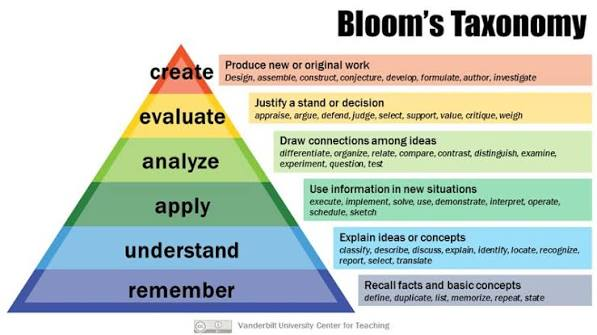
An approximate ranking of different kinds of thought. Notice that LLMs have been climbing this triangle, and actually have gotten to "create" before they've (visibly) gotten good at "evaluate".
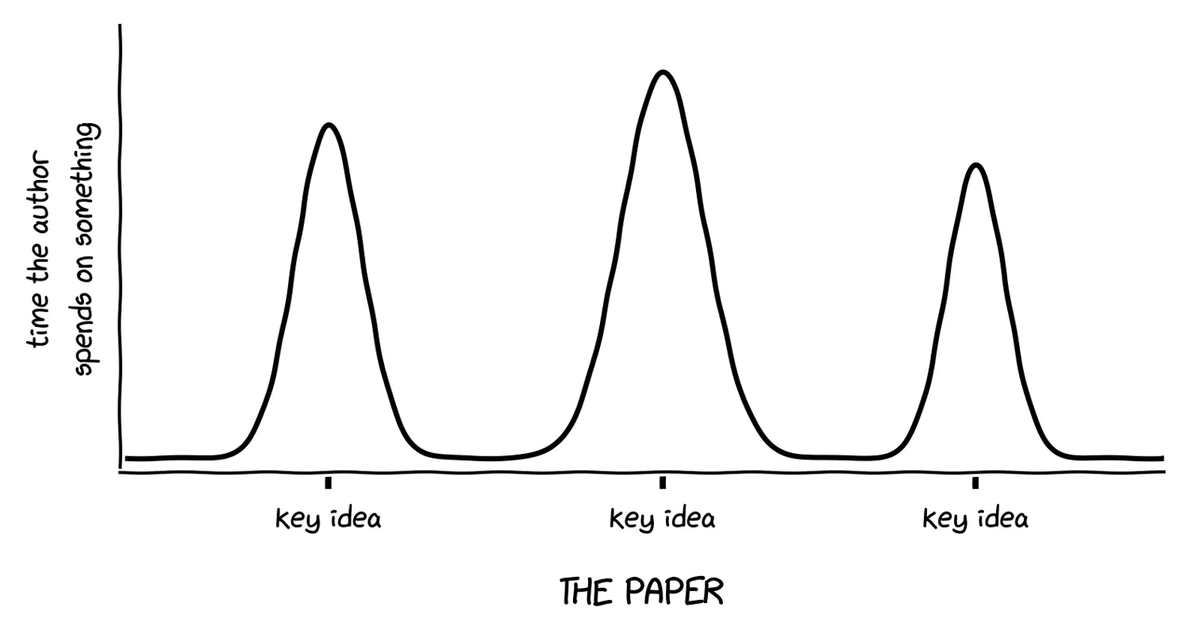
A key problem with the current models is that they are terrible at judging the relevance of something. This is one of their worst flaws. This is a problem for writing because humans operate on ideas, not prose. In any given paper, there are, like, maybe two new ideas they use. More if it's a good paper, and even more if it's a great paper. The thing is: humans realize this, and they structure their writing accordingly. They spend little, if any, time on boilerplate, and then almost all of their time on the actually new key ideas in their paper. This makes things far easier to learn, as you really only have to remember 2-3 new things (the new ideas), while your background knowledge can fill in the rest of the details. You can usually also get at least a gist of these ideas by just reading the introduction of the paper. Good papers are structured kind of like this:
How well-written papers are structured—only the necessary amount of time on boilerplate, with great care and effort spent on the few key steps that make everything work.
This is because the author knows that there are only a few actually new ideas in their writing, and so they will spend most of their time on the difficult content, and much less, if any, time on the trivial content.
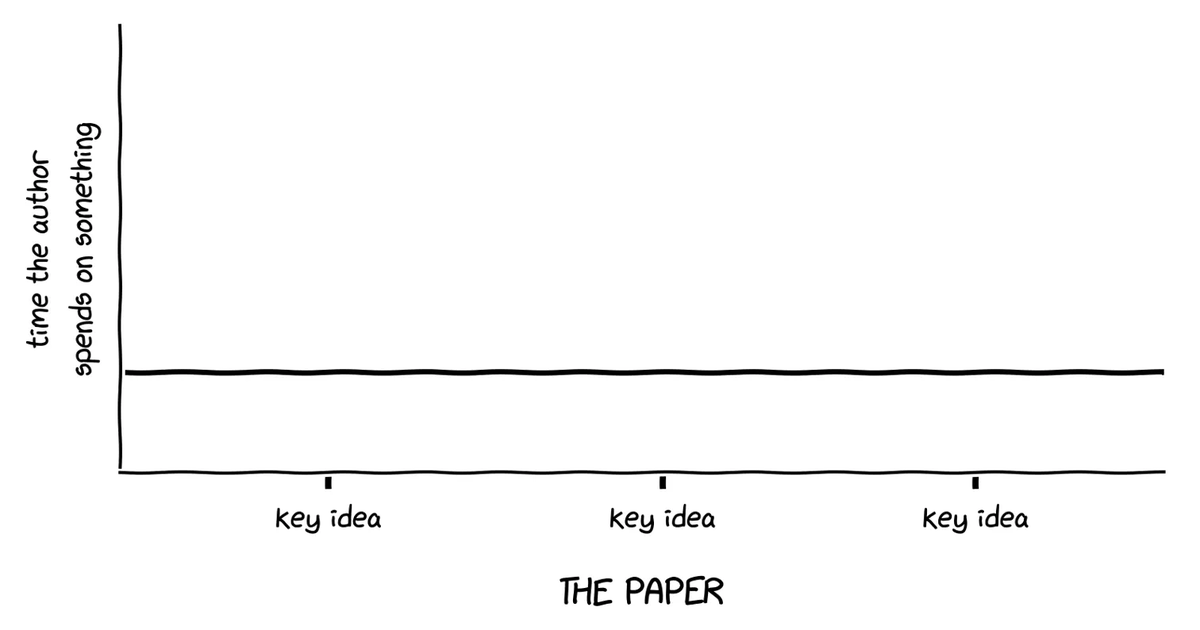
On the other hand, the standard LLM paper is written like this:
The average LLM paper...
Where are the new ideas? How are they delineated from the generic boilerplate that I learned in my first year of undergrad? Ha, wouldn't you like to know? Too bad. The model has other plans for you: it's going to do this really fun thing where it doesn't actually tell you the answer to these questions. Enjoy sifting through your slop.
This is an issue of relevance. The model seemingly has little ability to tell what information is genuinely important versus trivial, and its writing reflects its ignorance. There is a sort of constancy of the perceived importance of any given step in an LLM's output, yet this is of course completely false. Multiple Fields medalists have commented on this recently [22:00], [Goal 6.3], and it's one of the biggest inhibitors to both (a) good exposition and (b) automating mathematics research.
It's not really difficult to come up with concrete ideas on how to improve the model's ability to detect relevance, but I will withhold them from this post because they can equally be used for machine learning capabilities. Relevance will (almost) certainly be solved with scale and elicitation. It's clear that, in some sense, the models have a superhuman ability to evaluate the relevance of something, as they have solved scores of highly difficult math and physics problems. To do this, they surely have had to evaluate different solution approaches and decide which ones are more important than other ones. I am also sure that in the CoT it should be more or less clear when a critical idea arises. The only question is how to bring this ability to the surface to bear on the writing—and thinking—of the model.
Rationalists should realize that God is lot smarter than an artificial superintelligence
We can’t reasonably predict the behavior of superintelligent AI, so why should we assume that we can predict the behavior of an omniscient god?
The rationalist crowd correctly discerns the fact that you cannot reliably reason about the behavior of superintelligent agents. This idea is called “Vingean uncertainty”—the idea that less intelligent agents cannot accurately predict the behavior of far more intelligent ones. If they could predict their behavior, then they’d be just smart as the more intelligent agent, simply by taking all of the predicted actions. An example of this is a chess-playing AI—if I could predict the moves that Stockfish would make, then I could simply make those moves myself, thus being as good as Stockfish at chess.
Vingean uncertainty still allows one to make very general arguments about how superintelligent agents may act. Roughly, the extent of knowledge we have about such agents is isolated in the theses of instrumental convergence and the orthogonality thesis. The first says that goal-driven agents will aim to accumulate power, self-preserve, and not modify their preferences (among other things) in order to achieve their goals most efficaciously. The second says that desires are “orthogonal” to intelligence—that is, you can have an arbitrarily intelligent agent with arbitrarily specified goals. The classic example is a superintelligent AI with its main desire—and hence goal—being to make as many paperclips1 as possible.
The main reason you should be more or less agnostic about the actions of a superintelligent agent is because you’re not that smart. You can imagine that a jumping spider (which has been shown to have basic predictive abilities2) could not reliably predict basically anything about a human actor. It is not unreasonable to assume that this analogy scales to humans predicting the behavior of an ASI. Even more so when the ASI is very smart, similar to something like 100x the gap between a human and an amoeba. Even more so when the being you’re dealing with is infinitely intelligent, or omniscient. This is the situation we are dealing with when we reason about a superintelligent deity. If you’re a rationalist who accepts Vingean uncertainty, you should apply it to your religious credences as well.
In religious philosophy, this problem is called “divine psychology”—the idea that we can’t reliably reason about what God wants to do one way or the other. Itisalltheragein modern philosophy of religion3. It more or less destroys the problem of evil and divine hiddenness, but also destroys the fine-tuning argument and psychophysical harmony (among others). The idea behind this is that whatever minimal reasoning you can do about bad things, you can also do about good things. So if you have to discredit this reasoning on one issue, then you also have to discredit it on the other issue. If, for example, I can’t update away from theism4 on the fact that there seems to be gratuitous evil in the world because of divine psychology, then I also can’t update toward theism due to the seemingly absurdly fine-tuned constants of nature. There are rebuttals to this point—namely the Awesome Theistic Evidence argument (and the forthcoming Awesome Atheistic Evidence argument). The idea behind ATE is that it really seems like some things should be evidence of God, even if he is very mysterious and smart—for example, if we somehow found that the initial conditions of the universe spelled out the entire Gospel of John, it seems like that should be pretty strong evidence for Christianity. This is regardless of whatever giga-brained, 13D-chess considerations we have to account for when thinking about the psychology of the deity at hand.
We’ve applied rationalist considerations to philosophy of religion—let’s see if we can now go the other way. Is there an analog of ATE when reasoning about superintelligent AI?
I think there obviously is.
Imagine that, after Anthropic achieves RSI and creates an extremely superintelligent Claude somewhere in the year 2035, we give this agent total freedom of action. Claude then behaves in the following ways: it cures every known disease, spends gargantuan resources on improving human welfare at the seeming expense of its own power, voluntarily builds apparent control and shut-down mechanisms into itself for humans to use, and doesn’t take obvious opportunities to seize power. It does these behaviors for, say, 50 years, until 2085, and does them in every observable environment without any seeming strategic benefit to doing so.
It seems like it would be reasonable to conclude that Claude is probably just aligned to human values. Maybe Claude is secretly deceiving us for some incomprehensibly intelligent giga-brained strategic reason. But if that possibility prevented any update toward Claude being aligned, it seems like behavioral observations can teach us nothing about the true intentions of superintelligent models. That feels too skeptical to me.
Awesome Atheistic Evidence also has some play here. Imagine that instead, Claude starts converting literally everything in sight into paperclips, builds tons of paperclip factories, drains the oceans to supply the coolant for hardening molten paperclips, and starts genociding humans to use their atoms to build paperclips with.
I think it’s pretty reasonable to assume that Claude is now a paperclip maximizer, and thus is not aligned with human values.
This is without regard to the fact that Claude is vastly superintelligent, making the psychology of the model basically inscrutable to us. Even with this gap, we can make prima facie judgements about Claude’s actions when faced with overwhelming confirmatory evidence for a given hypothesis.
See, e.g., this quote from Bostrom in his book Superintelligence: “Suppose we have an AI whose only goal is to make as many paper clips as possible. The AI will realize quickly that it would be much better if there were no humans because humans might decide to switch it off. Because if humans do so, there would be fewer paper clips. Also, human bodies contain a lot of atoms that could be made into paper clips. The future that the AI would be trying to gear towards would be one in which there were a lot of paper clips but no humans.”
Do you really want your life’s work to be trading Peruvian banana futures one microsecond faster?
The smartest technical students at the top schools generally go into one of four career options:
Academia—this means becoming PhD and master’s students in physics, math, or computer science. For example, this is the most common path for MIT math majors1.
Consulting, Investment Banking, or FAANG SWE—reasonably well-paying careers with a relatively high amount of prestige. Quite competitive, but less so compared to the next two options.
AI capabilities research at OpenAI, Anthropic, xAI, etc.—the “new hot job” in town. Promises of massive salaries, very smart coworkers, and the opportunity to bring superintelligence to life.
Quantitative finance—extremely high salaries, genius coworkers, exciting work, and lots of prestige.
To gauge approximately how many of these top students go into quant, about 25% of MIT’s math majors go into finance [1]. From my personal experience, I think it’s reasonable to assume that at least 10% of the top technical students at the best universities go into quantitative finance. The reasons for doing this are pretty simple: you make a lot of money, you have really smart coworkers who are familiar with your social circle2, you get lots of prestige, and the work is interesting.
I posit that if you are a quant intern, you should instead go into AI safety. It’s not hard to see why: you will have the same four elements that make quant work interesting, but you’ll actually be doing something useful with your life. It is completely obvious that quants have basically zero positive impact on the world unless they donate large amounts of their income. Technical AI safety, on the other hand, is easily the most important work any technical person on the planet can do with their life. Plus, you still get almost all of the cool benefits of quantitative finance!
Making lots of money. The salary for a technical alignment researcher at an independent organization is around $200k, and at a top independent org (e.g. Redwood, METR, Apollo, FAR.AI, etc.) you make ~$300-800k. If you work at a frontier lab (e.g. OpenAI or Anthropic), you make ~$500k. The latter number is approximately equal to an introductory quant job at a top firm like Jane Street. So, if you’re going to Jane Street for the short-term money, that is no longer a reason to go there comparative to AI safety. The salary for independent labs can be less than introductory quant firm salaries, but not by more than $150k in most cases. This still probably doesn’t matter: more income has dramatically diminishing returns for well-being past ~$100k. Past this number, there is very little reason to optimize for income over other factors in your work. I would actually guess that the reason people care about income past ~$100k is status-signaling—saying that you make a large amount of money feels good, and so people like higher numbers here to flex on their friends and community.
Having really smart coworkers. Hard truth: your coworkers likely will not be as talented in AI safety as they would be in quant. This is simply because the field is much smaller and less developed than quantitative finance. It’s similar to how quant was in ~1990-2000—the field was just emerging, so most of the really smart people were in e.g. SWE or more traditional finance roles. However, you will still have lots of talented coworkers, and the more prestigious the lab is the more talented your coworkers are likely to be. I would say you start seeing a high frequency of quant-level talent when you get into the top-level independent labs, e.g. Redwood Research or METR, and this likely only increases at frontier labs. At a frontier lab, the talent levels are most likely the same as top quant firms.
Prestige. Unless you work at a frontier lab, this is the main hit you’d take relative to quant. If you go to anyone in a technical major at MIT, they all know what quantitative finance is. Many fewer of them know about AI safety, and about why it’s important. Two arguments for why this shouldn’t really sway you. One, it’s insanely obvious that you should not put random prestige-maxxing tendencies over trying to solve the problem of AI killing everyone on planet Earth. Two, prestige is solved if you just work at a top lab. Saying you work at Anthropic is arguably more sexy than saying you work at Jane Street nowadays. If you can’t live without having a visibly stacked LinkedIn, then work at a frontier lab.
Interestingness of the work. Quant work is interesting for two main reasons: you get to play with lots of money and you get to do lots of quick thinking about coding and mathematics. The work is also interesting because you have interesting coworkers, but this was covered in the previous point. Moving lots of money around is fun because it feels important. Doing lots of quick thinking about math and coding is fun because rapidly thinking about technical subjects is fun. I would argue that both of these elements are present in AI safety in varying amounts. First, the work in AI safety is clearly more important than the work in quant: you are working on the problem of keeping literally everyone on the planet Earth from dying. Aligning artificial intelligence is the most important technical problem of the generation, and that’s the problem you get to work on every day. Second, you will be doing less “quick thinking” than in quant, but you will still be doing lots of interesting coding work every day. I would say the work is approximately equal in interesting-ness across quantitative finance and AI safety, with a bias toward quant finance for most people.
In summary, if you’re a quant intern, you should instead go into AI safety. This is for four reasons. First, you will make basically the same amount of money. Second, you will have very interesting coworkers. Third, you will get lots of status. And fourth: the work is interesting. This makes the job itself approximately equal to quantitative finance. AI safety then absolutely topples quant finance when you consider the importance of the work. Therefore, you should work in AI safety. If you don’t agree that AI doom is likely to occur, please check out The Alignment Problem from a Deep Learning Perspective or Is Power-Seeking AI an Existential Risk? If you want another good opinion from Neel Nanda, two-time IMO gold medalist and current Head of Interpretability at Google DeepMind, read this.
If you are interested in getting into AI alignment work, I’d recommend reading this guide, or this post.
1 Around 50% of MIT math majors enter graduate school, although I expect this number to dramatically decrease in the next few years due to AI’s effect on math, physics, and computer science.
2 By “in your social circle”, this approximately means that most of them (1) know about olympiads and probably did math competitions as a kid, (2) have similar beliefs to you about many things, e.g. what is important in a career, what is interesting, etc. and (3) did basically the same things as you in undergrad and high school (e.g. taking lots of math/physics/CS grad classes, doing the same kinds of internships, attending similar social clubs, etc.).